

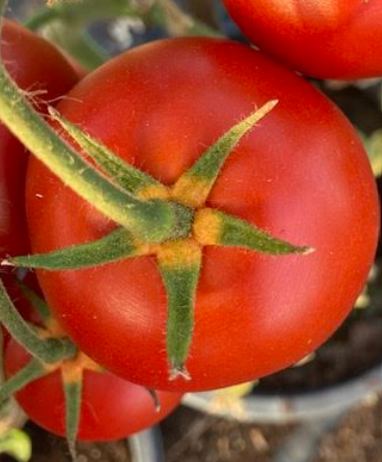
For many tomato growers, particularly those producing high-quality and exhibition fruit, the yellowing of the calyx is a long-standing frustration. The fruit itself can be perfectly formed, evenly coloured, and well flavoured, yet the calyx yellows prematurely, spoiling presentation and raising the same question year after year: why does this keep happening?
Over the years, I had heard many theories from growers. Some blamed overfeeding, others underfeeding. Weather stress, varietal quirks, or fruit being left on the truss too long were all suggested. What was missing was clear evidence. That changed when a chance conversation set in motion a two-year investigation involving experienced growers from the National Vegetable Society.

An Early Lead from Commercial Production
The starting point came at the Scottish National Vegetable Society branch seminar in November 2023. I had given a talk that day about how the world’s heaviest onion was grown in living soil. At the end of the event, all the guest speakers were invited on stage for an interactive Q&A. It was during this session that Ian Simpson raised the question of yellowing tomato calyx.
The issue was clearly widespread among exhibition growers, and from grower reports, it appeared to be more prevalent in certain varieties, such as ‘Maisey’ and ‘Damaress’.
I didn’t have a direct answer at the time, but the question stayed with me. A few months later, in January 2024, I was looking into sap analysis, a relatively new technique that analyses the nutrient content of plant sap, when I came across a Dutch pictorial guide to nutrient deficiencies in tomatoes produced by NovaCrop in the Netherlands. The images showing boron deficiency were an almost exact match for the yellow calyx symptoms being reported.
I shared this with Ian, who then contacted NovaCrop directly. Through correspondence with a plant nutrition specialist, it was confirmed that this disorder is recognised in professional tomato production, where it is often referred to as “yellow crown”. NovaCrop explained that commercial glasshouse growers typically manage this by maintaining boron levels of around 0.8–1 ppm in their irrigation feeds, which are applied with every irrigation.
That figure immediately raised an important concern, because most amateur growers are not using complete nutrient solutions, or feeding with every watering.

Why Boron Deficiency Is Commonly Overlooked
Amateur tomato growers usually rely on a mix of composts, soluble feeds, and organic top-dresses. Calcium inputs are often high, particularly where growers are trying to prevent blossom end rot using Cal-Mag products, calcium nitrate, or manure-rich soils.
Boron is required only in trace amounts, but it plays a critical role in cell wall formation, calcium transport within the plant, and fruit development. Several factors make deficiency surprisingly easy to induce:
- Boron is readily leached from soils, particularly those with low cation exchange capacity
- High calcium availability can suppress effective boron uptake
- Many soluble feeds contain boron, but usually at very low concentrations, often around 0.05 to 0.2 ppm
This helps explain why growers using very different feeding regimes, including high potash feeds, high nitrogen feeds, and organic liquid feeds, can all see the same yellow calyx symptoms.
From Theory to Field Trials
Rather than relying on theory alone, I wanted to test how this behaved under real growing conditions. Working with Ian Simpson, Neil Muirhead, and Simon Smith, we set up a structured trial over two growing seasons.
Each grower used a different cultivation method. Ian grew tomatoes in greenhouse borders trenched with manure, as well as in a polytunnel system using bottomless pots. Neil used large containers filled with a blend of potting soil and compost. Simon grew in raised beds supplemented with homemade organic feeds. This variation helped ensure the results were not specific to a single system.

The trial required controlled trace element inputs, alongside a separate boron source to allow rates to be adjusted independently. A baseline trace element supplement, Ecothrive Trace, was used to supply a balanced profile, including boron at 0.5 ppm when applied at 0.5 ml/L. However, based on the NovaCrop guidance, some varieties showing yellow calyx symptoms appeared to require higher boron levels, closer to 0.8–1 ppm.
To test this without oversupplying other trace elements, I formulated an additional liquid boron supplement, allowing total boron input to be increased independently.
We tested four feeding strategies:
- A baseline feed only
- Baseline feed plus Ecothrive Trace (0.5 ml/L)
- Baseline feed plus Boron supplement (1 ml/L)
- Baseline feed plus both the Ecothrive Trace (0.5 ml/L) and the Boron supplement (0.5 ml/L), referred to as the “three-way mix”
Application rates were calculated carefully to avoid toxicity, with treatments ranging from modest supplementation up to levels comparable with commercial glasshouse practice.
Trial Results Across Two Seasons
Across two seasons and multiple growers, the results were consistent.
Baseline feeding alone reliably produced yellowing of the calyx. Adding a trace element supplement alone did not supply sufficient boron to fully resolve the issue. Supplying boron on its own often led to reduced plant vigour, smaller fruit, and in some cases, early plant decline.
The most effective approach was the combined use of a balanced trace element input alongside additional boron. Where boron was supplied within a complete trace element programme, calyx yellowing was dramatically reduced or eliminated.

Grower-specific observations supported this pattern. Neil Muirhead achieved complete suppression of yellow calyx using a relatively high boron input. Although his application was less precise, it did not result in negative effects and helped establish a practical upper threshold. Ian Simpson and Simon Smith found that slightly lower, more controlled application rates were almost as effective, with only minimal late-season symptoms.
Seasonal effects were also clear. As light levels dropped and temperatures cooled later in the season, transpiration slowed, and nutrient uptake declined. Where feeding strength was not increased to compensate for reduced uptake, the yellow calyx began to reappear on later trusses. This aligns with commercial practice, where nutrient concentrations are increased later in the season to maintain adequate uptake.

Key Findings
By the end of the second year, several conclusions were clear:
- Yellow calyx is a boron-related nutritional disorder
- The issue is rarely total boron absence, but insufficient boron relative to other elements, particularly calcium
- Boron is most effective when supplied as part of a balanced trace element programme
- Supplementation is most effective from first truss set onwards
- Feeding strategies must adapt to seasonal changes in transpiration
Most importantly, these trials showed that the yellow calyx is not an unavoidable characteristic of certain tomato varieties. With appropriate nutrient management, it can be controlled.
Practical Implications for Growers
What began as a recurring question at grower seminars developed into a practical, evidence-based solution through collaboration between experienced amateur growers and professional plant nutrition specialists.
Thanks to the work of Ian Simpson, Neil Muirhead, Simon Smith, and Fiona Shenfield, along with technical input from NovaCrop, there is now a clearer understanding of both the cause of yellow calyx and how to prevent it.
Weather will always influence growing outcomes, but one point is consistent. Boron management, balanced with calcium and supported by a full trace element programme, needs to be treated as a core part of tomato nutrition, not an afterthought.
For more information about Ecothrive Trace and the Boron Supplement used in the two-year trial, visit www.ecothrive.co.uk.


Leave a comment
This site is protected by hCaptcha and the hCaptcha Privacy Policy and Terms of Service apply.