

Prefer to listen? Use the audio player below to hear us read this lesson instead of reading it yourself.
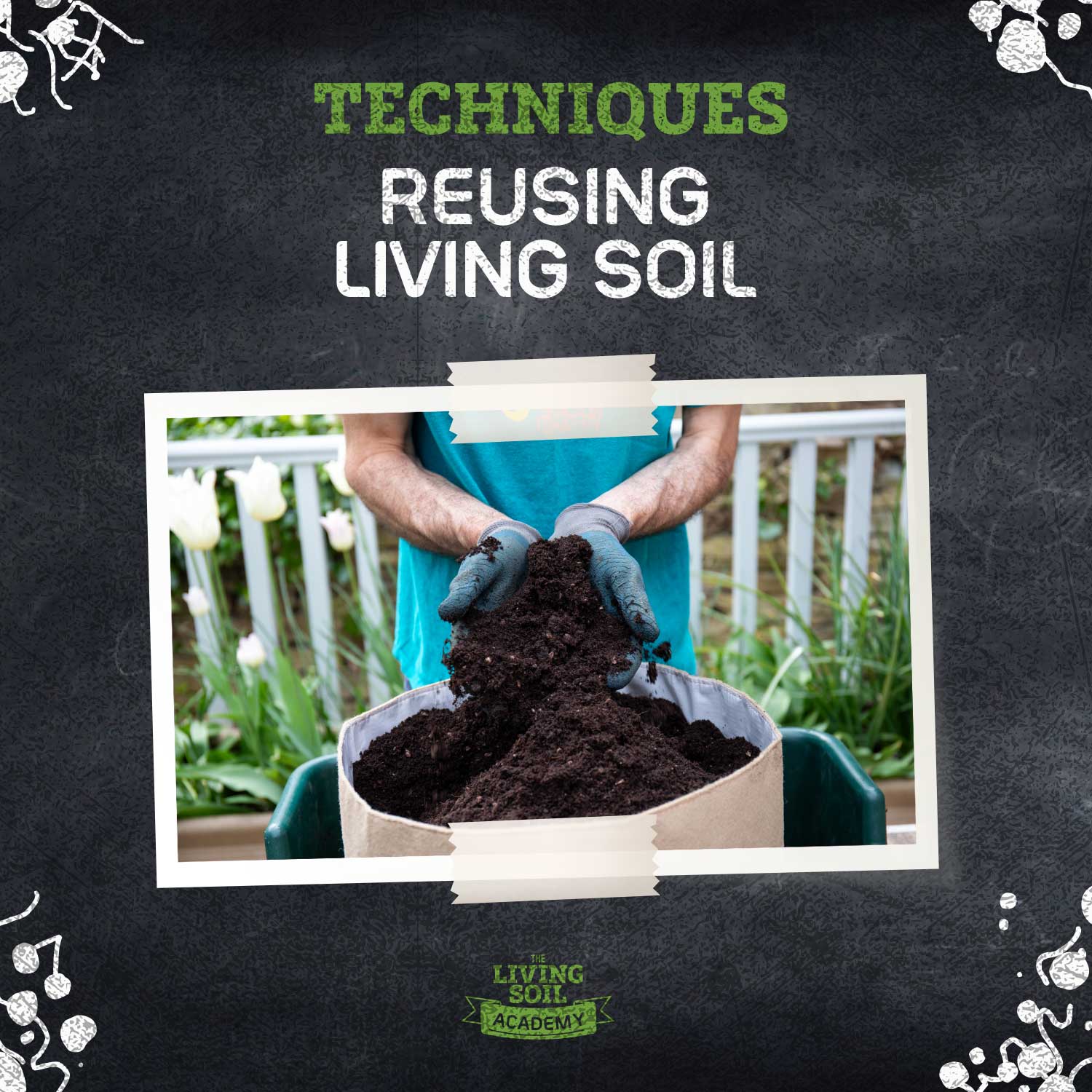
After a full grow cycle, your soil has supported significant biological and nutritional activity. Nutrients have been pulled out, microbial populations have been active throughout, and the upper layer is often the most affected.
Re-amending restores the soil to a balanced, nutrient-rich state, preparing it for the next cycle. The quantity required depends on how the previous cycle progressed, how frequently top-dressing was applied, and the size of the containers or beds.
In smaller pots, the full volume is typically amended. In larger beds, only the top 15–25 cm is refreshed, as this is the most actively depleted zone.
Reusing soil reduces waste, improves consistency, and allows the system to develop over time into a more stable and resilient ecosystem.
Why Re-amend After a Cycle
Living soil is expected to change over the course of a cycle. Plants remove nutrients, microbes process organic inputs, and the balance shifts as growth progresses.
After harvest, the remaining soil requires replenishment.
The amount of amendment needed will vary. Factors such as plant genetics, watering practices, environmental conditions and light intensity all influence nutrient demand and depletion rates.
Without a soil test, one practical approach is to assess how plants finished. Early fading or reduced vigour toward the end of flowering may indicate that nutrient reserves were depleted. In this case, a higher re-amendment rate is appropriate.
If plants remained very green late into the cycle, often due to heavier feeding earlier on, a lower amendment rate may be sufficient. The goal is to replace what was removed without creating excess.
Growing practices also influence this balance. Cover cropping, chop-and-drop methods, or returning plant material to the soil can affect nutrient availability over time. However, undecomposed plant material releases nutrients slowly, so composting externally and reintroducing finished compost is often a more controlled approach.
No-Till or Low-Till?
Early approaches to living soil often focused on minimising disturbance to preserve biological structure, particularly fungal networks.
While this approach can work, light disturbance at the end of a cycle has shown practical benefits in many systems.
Top-dressing alone can struggle to restore nutrient levels evenly throughout the root zone, especially after heavy depletion. Mixing amendments into the top 15–25 cm allows nutrients to be distributed more effectively and supports more consistent plant growth in the following cycle.
This process also helps to relieve compaction and improve soil structure.
Although this may seem counter to biological preservation, living soil systems tend to be highly resilient. Microbial communities re-establish quickly, and in practice, light reworking of the top layer does not appear to negatively impact long-term biological function.
Container Size and Re-amending
Soil volume plays a key role in how re-amending is approached.
Smaller pots deplete more quickly and require more frequent inputs. Larger containers and beds hold greater nutrient reserves and tend to remain balanced for longer periods.
In smaller pots, the entire soil volume is typically amended, as roots and biology occupy the full space.
In larger pots, particularly those deeper than 25 cm, re-amending is often focused on the upper layer. Nutrients tend to accumulate lower in the profile over time, so concentrating inputs in the top section helps maintain balance without overloading deeper zones.
Practically, re-amending is also easier in larger containers. Smaller pots often develop dense root structures that require the soil to be removed and broken up before amendments can be incorporated. Larger pots allow amendments to be mixed into the upper portion more easily.
In beds, a gentler approach is used. The top 15–25 cm is refreshed, creating a nutrient-rich surface layer that integrates gradually through watering, while deeper biological structures remain largely undisturbed.
During the re-amending process, it is also important to assess the physical structure. Over time, repeated additions of compost and organic matter can increase density in the upper layer. Adding aeration material such as pumice can help maintain structure and prevent compaction where needed.
What to Re-amend With
Re-amending requires a balanced combination of inputs that release nutrients at different rates and support the soil across the full cycle.
Some growers choose to build their own blends using individual amendments, while others prefer a more structured approach using pre-formulated mixes. The key is ensuring that nutrients are supplied in a way that matches plant demand over time, rather than all at once.
At Ecothrive, our Re-Gen blend was developed specifically for this purpose. It is based on data from a large number of soil tests taken at the end of real growing cycles, where nutrient levels had been measured after harvest. This has allowed us to build a clearer picture of what is typically removed from the soil and what needs to be replaced to restore balance.
Re-Gen combines nitrogen, phosphorus, potassium, calcium, magnesium, sulphur and trace elements from a range of fast, medium and slow-release sources. This supports early plant development, provides a steady supply through the cycle, and maintains enough residual nutrition into flowering.
For growers who prefer to create their own blends, it is important to consider how different inputs break down over time. Combining several nitrogen sources with varying release rates, alongside calcium and magnesium inputs such as gypsum and Epsom salt, can help maintain a more even nutrient supply.
Once amendments have been incorporated into the soil, watering with a microbial extract can help re-activate biological processes and support the breakdown of nutrients.
It is also common to see a temporary increase in soil temperature following re-amending. This is a normal result of increased biological activity, and many growers allow the soil to stabilise before replanting.
The Benefits of Reusing Your Soil
Reusing living soil offers several practical and long-term advantages.
Reduced waste and ongoing input
The soil remains in place and improves over time, reducing the need to replace growing media between cycles.
Cost efficiency over multiple cycles
Once established, soil can be reused repeatedly with only targeted re-amendment. Many growers run multiple cycles in the same soil, significantly reducing long-term input costs.
Development of a stable biological system
Over time, the soil ecosystem becomes more adapted to the specific growing environment. Microbial populations adjust to consistent conditions, contributing to improved resilience and more stable plant performance.
As the system matures, nutrient cycling becomes more efficient, plant health becomes more consistent, and overall crop quality can improve.
Final Thoughts
Re-amending is part of maintaining a living system over time. Rather than resetting the soil each cycle, it allows the system to develop, adapt and improve with each run.
By understanding how nutrients are depleted and replenished, and by applying amendments with balance and consistency, growers can maintain soil performance while reducing variability between cycles.
Over time, this approach leads to a more stable and predictable system that continues to improve with use.

Leave a comment
This site is protected by hCaptcha and the hCaptcha Privacy Policy and Terms of Service apply.