

Prefer to listen? Use the audio player below to hear us read this lesson instead of reading it yourself.
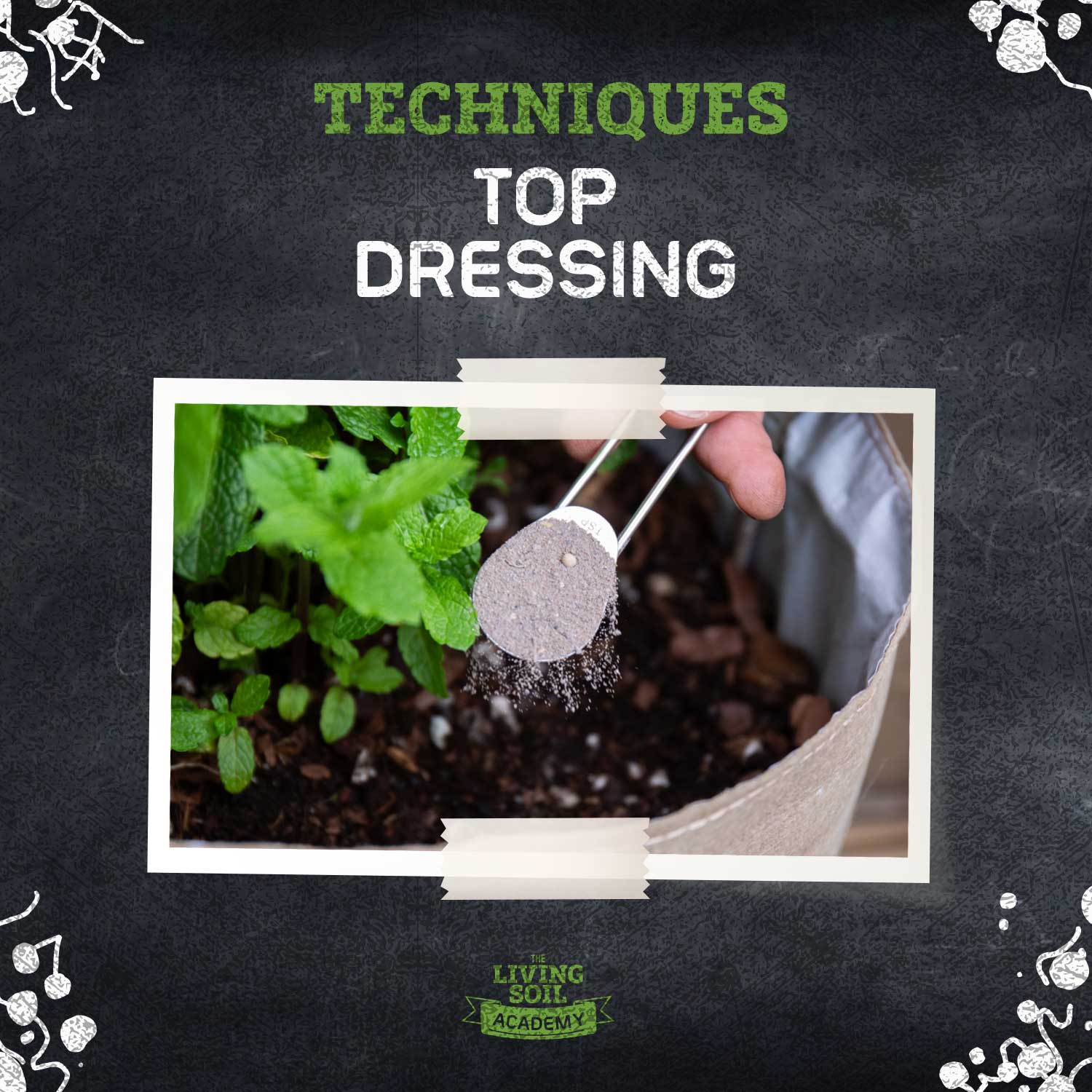
Top-dressing, in an organic growing context, refers to applying dry amendments such as rock powders or plant-based inputs to the soil surface to replenish nutrients.
Living soil is a biological system. In controlled indoor environments under high-output lighting, plants use nutrients rapidly. To maintain balance and productivity, nutrients removed by the plant must be replaced over time.
There are two main approaches. Soluble nutrition provides immediately available nutrients directly to the plant, while top-dressing relies on dry organic amendments that are broken down by soil biology, releasing nutrients gradually.
Dry Amendments
Dry amendments can be used individually to target specific needs, or combined to create an amendment blend with a more complete nutritional profile.
Pre-formulated blends are often used to simplify this process and provide balanced nutrition throughout the cycle. At Ecothrive, our Grow, Bloom and Re-Gen blends were developed through a combination of lab testing and grow room trials to deliver nutrients at appropriate ratios across different stages of growth.
Once you understand how much to apply, the next step is ensuring those inputs are delivered to the soil effectively. Our Living Soil Feeding Schedule Calculator can be useful here, helping you tailor application rates based on container size, canopy and growth duration.
Applying a Top Dress
Applying dry amendments is straightforward, but a few practical steps help improve consistency and reduce issues.
Pre-blending
Dry amendments can be dusty and difficult to distribute evenly. Pre-blending them with a small amount of fresh soil before application reduces dust, improves distribution, and ensures better contact with the soil surface.
As a general guide, mixing approximately 100–200 ml of soil with 15–30 g of amendments creates a workable blend.
This can be done by hand in a separate container, or by placing the materials in a sealed tub and shaking to combine. Pre-blending also helps the amendments integrate into the soil surface, allowing them to break down more evenly over time.
Once applied, maintaining adequate surface moisture is important to support decomposition.
Direct application
If amendments are applied directly to the soil surface, lightly working them into the top 2–4 cm can improve contact. This is generally more suitable for larger pots or beds, as disturbing the surface in smaller containers or later growth stages can affect roots near the surface.
Using compost or worm castings
Compost or worm castings can also be used as part of the top-dress mix. When doing so, adding some aeration material, such as pumice helps prevent compaction and surface crusting.
Managing Surface Conditions
Crusting of the soil surface is a common issue, particularly when large quantities of amendments are applied to smaller containers.
When growing in smaller containers, think ahead when filling the pot and allow some space at the top. This makes it easier to incorporate additional pre-blended top-dresses later without overloading the surface.
Crusting can also occur when the surface dries out. In these conditions, amendments will not break down effectively, and nutrient release slows. Where maintaining surface moisture is difficult, a mulch layer can help reduce evaporation and support more consistent conditions.
Avoiding Over-Application
Living soil systems rely on balance. It is possible to add too many inputs, particularly when combining multiple amendments, composts or biological stimulants.
Excessive inputs can disrupt nutrient balance and create conditions that are difficult to correct without proper analysis. Soil testing is often required in these situations to understand what nutritional adjustments are needed.
A measured approach to inputs, with attention to quantity and timing, helps maintain stability within the system.
Mineralisation Rate
Amendments are converted into plant-available nutrients through a complex biological process known as mineralisation. Different inputs break down at different rates, and this should be considered when selecting amendments at each stage of the plant cycle.
Plant-based inputs such as alfalfa, seaweed meal, neem and karanja cake tend to mineralise slowly, often providing limited nitrogen in the first 2–3 weeks after application.
Mealworm frass and bone meal release nutrients at a more moderate rate, with noticeable nitrogen becoming available around a week after application. Frass can supply phosphorus more readily in the short term, while bone meal releases phosphorus more gradually over a longer period. For this reason, bone meal is typically more effective when incorporated into the soil ahead of planting.
Faster-acting amendments such as insect meal and blood meal begin releasing nitrogen within a few days of application, while soy amino hydrolysate is immediately available. These faster-release inputs should be used with greater care, as nitrogen becomes available more quickly and can lead to over-application if not managed correctly.
Mineral inputs such as gypsum and calcium carbonate have relatively low solubility and release calcium slowly over time. Rock phosphate and volcanic rock dust are most effective when finely ground, as a smaller particle size improves availability within a living soil system.
At Ecothrive, our Soil Food Grow and Bloom blends were developed with these mineralisation patterns in mind. They are formulated primarily with fast and medium-release inputs, alongside smaller proportions of slower-release materials. This helps ensure that nutrients become available within a useful timeframe, while reducing the risk of excess nutrients accumulating in the soil.
If You Run Into Problems
If the soil becomes unbalanced, the first step is to understand its current condition.
Soil testing is a common and valuable tool, particularly in larger or long-term systems. Results can be used to guide targeted adjustments and restore balance quickly and effectively.
For growers who prefer a more structured approach, balanced amendment blends can simplify feeding decisions. For more targeted corrections, individual inputs can be used once the specific requirement is understood.
Biology Does More Than Feed Plants
Soil biology plays a central role in nutrient cycling, but its influence extends beyond basic nutrition.
Microorganisms produce a wide range of compounds that affect how plants interact with their environment. Organic acids can improve mineral availability, while signalling compounds influence plant responses to stress and pest pressure.
These biological processes also contribute to characteristics such as flavour, aroma and overall crop quality. The expression of compounds such as terpenes and flavonoids is influenced not only by plant genetics but also by the activity of the soil food web.
When biological systems are functioning well, plant performance reflects that stability.
Final Thoughts
Top-dressing is a way of supporting the soil system over time rather than responding to short-term plant demand. When applied with consistency and restraint, it allows biology to regulate nutrient release and maintain balance.
Understanding how amendments interact with soil, moisture and biology makes it easier to apply inputs effectively and avoid unnecessary corrections later.

Leave a comment
This site is protected by hCaptcha and the hCaptcha Privacy Policy and Terms of Service apply.