

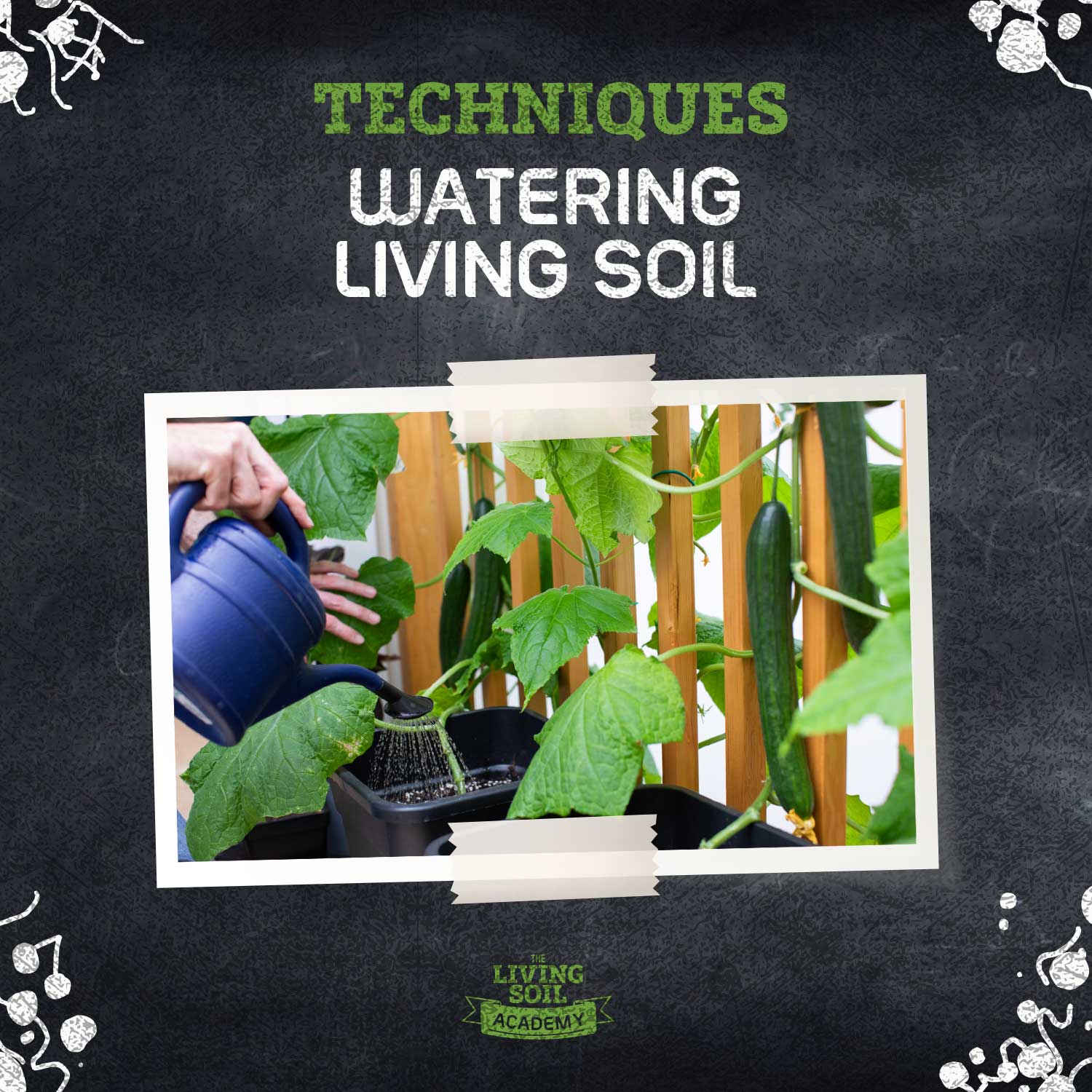
Prefer to listen? Use the audio player below to hear us read this lesson instead of reading it yourself.
Why Watering Matters
Watering in living soil is not just about keeping plants hydrated. It is about maintaining the biological system within the soil.
Microorganisms are responsible for breaking down organic matter and releasing nutrients. When the soil becomes too dry, biological activity slows or enters dormancy. When it remains too wet, oxygen levels drop and microbial function is reduced. Soil moisture directly influences both nutrient availability and microbial activity, making it one of the most important factors to manage.
Understanding Moisture and Nutrition
Plants take up nutrients largely through transpiration - the movement of water from the soil, through the roots, and out through the leaves.
Even in a well-amended soil, nutrients will not be available if the soil has dried back and biological activity has slowed. Watering practices are therefore closely linked to nutrient availability. In living soil, watering supports not just the plant, but the microbial system that supplies its nutrition.
Watering by Growth Stage
Watering requirements change as plants develop and are influenced by both plant size and soil volume.
Seedlings and early vegetative plants have a lower water demand and are more sensitive to excess moisture. At this stage, lighter applications with close observation tend to work best.
As plants establish in their final containers during late vegetative growth and early flowering, water demand increases. Larger plants in larger volumes of soil are capable of taking up significantly more water each day.
A practical guideline for pots of 40 litres and above is to apply around 5–10% of the container volume per watering.
For example, in a 56-litre pot containing approximately 50 litres of soil, this equates to 2.5 to 5 litres per application.
This should be adjusted based on plant size, environmental conditions, and how quickly the soil dries.
At peak growth, when you have a full canopy, it's important to know you are reaching saturation with at least one watering session per week. This does not require regular runoff, although getting a little is fine.
In smaller pots, particularly where canopy size is large relative to soil volume, more pronounced dry backs are common. In these situations, higher watering volumes, sometimes up to 20% of container volume, may be required to rehydrate the soil effectively.
The overall aim is to maintain steady, consistent moisture that supports active biology while meeting the changing demands of the plant.
Toward the end of the growth cycle, water demand typically decreases. Allowing the soil to dry slightly more during this stage can support the natural senescence process.
Checking Moisture
Traditional methods, such as lifting pots or sticking your finger into the top layer, can be less effective in living soil systems.
In larger containers, weight is harder to assess accurately, and biological activity depends on maintaining a narrower moisture range than in inert media like coco. Surface checks can indicate whether soil is wet or dry, but they provide limited insight into moisture levels deeper in the root zone.
Why Tools Help
Using a moisture measurement tool can provide a more consistent and reliable understanding of soil conditions.
Tensiometers, such as the Blumat Digital, measure the effort required for roots to extract water from the soil. Higher readings indicate drier conditions and increased plant stress.
In coco-based living soil systems, maintaining moisture levels between approximately 40 and 80 millibars during peak growth has been associated with strong biological activity and consistent nutrient availability. This range supports both plant access to water and ongoing microbial function. Going lower than 40mbar for short periods of time, to ensure you have reached saturation, is totally fine. Try to avoid going higher than 100mbar in peak growth.
Pot Size and Watering Work Together
Soil volume plays a central role in moisture stability. Larger pots retain moisture for longer periods and make it easier to remain within the optimal range. Smaller pots dry more quickly, narrowing the window in which biological activity can remain stable.
For this reason, pot size and watering strategy should always be considered together. Greater soil volume provides increased nutrient availability, improved moisture stability, and a larger buffer against fluctuations.
If Things Go Wrong
Periods of extended dryness or inconsistent moisture can lead to reduced biological activity and symptoms of nutrient deficiency.
The first step in resolving this is to restore appropriate soil moisture levels. In cases of severe dry back, the use of an organic wetting agent can help rehydrate the soil more effectively.
Biological activity may take time to recover. During this period, some growers choose to apply small amounts of soluble organic nutrition to support the plant while microbial processes re-establish.
Final Thoughts
Watering in living soil is ultimately about maintaining consistency within the system. When moisture levels are kept within an appropriate range, biological activity remains stable and nutrient cycling continues to function as intended.
With the right balance of soil volume, moisture management and observation, the system becomes easier to manage and more predictable over time.

Leave a comment
This site is protected by hCaptcha and the hCaptcha Privacy Policy and Terms of Service apply.