

Prefer to listen? Use the audio player below to hear us read this lesson instead of reading it yourself.
Pot Size Matters
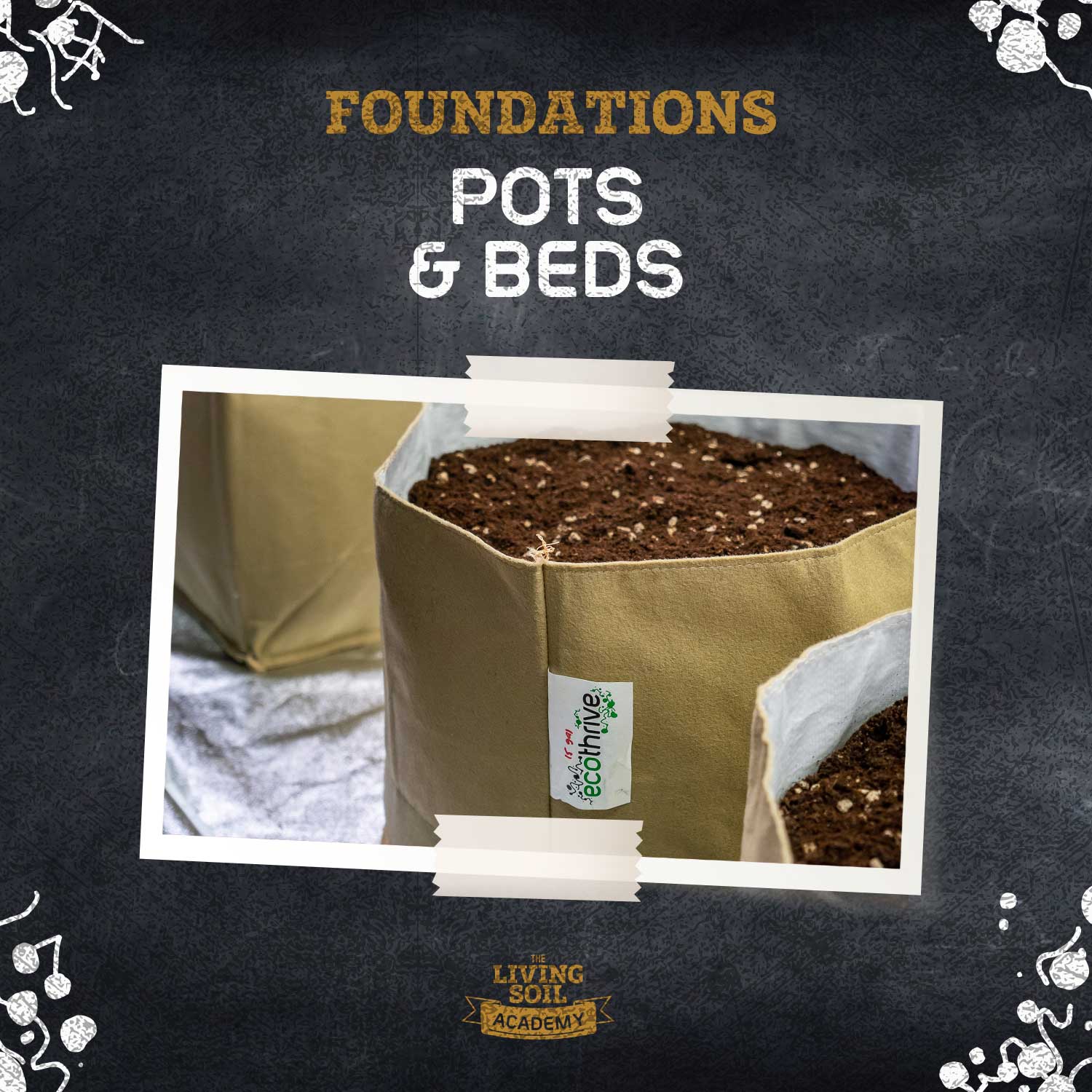
In living soil, pot size is a functional decision rather than just a number. We recommend using 45–60 litres of soil per pot, with four pots for every 1.2 square metres. This guidance is based on consistent observations of what allows the system to perform reliably.
Living soil is a biological system. Nutrients contained in dry organic amendments must be broken down by microbes before they become plant-available. In smaller pots, there is less soil to hold both nutrients and water. As a result, the soil dries more quickly, and biological activity can slow or stop. Even short dry periods can have a lasting impact on a system supporting fast, healthy plant growth.
Understanding Soil Volume
It can be helpful to think of soil as a bank of nutrients. The greater the soil volume, the larger the reserve.
In larger pots or beds, there is more capacity to store nutrients and maintain consistent moisture levels. This creates a buffer against fluctuations and allows the system to function more steadily. Smaller pots hold less, which means less buffering and a greater reliance on precise watering and feeding.
Smaller containers can still be used successfully, but they require closer management.
Smaller Pots: Possible, but More Demanding
Growing in smaller pots is entirely possible, but it changes how the system behaves.
Organic amendments depend on consistent moisture to mineralise at a steady rate. In smaller volumes, maintaining the optimal moisture range for microbial activity becomes more difficult. This can lead to inconsistent nutrient availability.
A key concept is the relationship between canopy size and total nutrient demand. The size of the canopy determines how much nutrition is required over the full life cycle, regardless of how that canopy is distributed across individual plants.
For example, a 1.2 m² canopy filled with nine 20-litre pots contains significantly less total soil volume than the same space filled with four 20-litre pots. With less soil, there is a smaller nutrient reserve, meaning more frequent or heavier top-dressing may be required. This also increases the need for careful moisture management to maintain nutrient availability.
Where large canopies are paired with limited soil volume, growers often find that combining top-dressing with occasional liquid feeding provides more consistent results.
Matching Pots to Plant Stage
Container size should reflect plant development above ground.
Seedlings and early vegetative plants have lower water and nutrient demands and are easier to manage in smaller volumes while roots establish. As plants grow, their demand increases, and larger pots or beds become necessary to maintain stability within the system.
Transplanting before a plant becomes rootbound ensures roots have access to sufficient oxygen, moisture and nutrients. This supports continued growth without unnecessary stress.
A common approach is to begin with propagation plugs for seeds or cuttings, transplant into small pots of around 1–4 litres, and then move into the final pot or bed once the plant is well established.
Matching container size to plant stage allows both the plant and the soil biology to function effectively.
Why Larger Beds Are Often Preferred
Larger soil volumes provide a more stable growing environment.
In beds, moisture levels are easier to maintain, nutrient reserves are greater, and microbial populations remain more active. This stability reduces variability and allows the system to operate more consistently across the full growth cycle.
For many growers, this translates into healthier plants and more predictable results.
Practical Tips for Pots and Beds
A few key principles can help guide decision-making:
Start with a sufficient baseline - Around 50 litres of soil per pot provides enough volume for biological processes to function effectively while remaining manageable.
Think in terms of the nutrient bank - Larger soil volumes store more nutrients and provide a buffer against mistakes or fluctuations.
Be aware of dry backs - Smaller pots dry out more quickly. Even short periods outside the optimal moisture range can slow microbial activity and nutrient cycling.
Adjust feeding to suit volume - Where soil volume is limited, inputs may need to be more frequent and carefully managed.
Prioritise consistent moisture - Maintaining the correct moisture range is one of the most important factors in supporting biological function and overall system stability.
Final Thoughts
There is no single correct way to approach container size in living soil. The key is understanding how soil volume, moisture, and nutrient availability interact within the system.
Larger pots and beds provide greater stability and margin for error. Smaller pots can still perform well, but require more precise management to maintain balance.
In all cases, the goal remains the same: to create a system where the soil can function effectively and support consistent, healthy plant growth.

Leave a comment
This site is protected by hCaptcha and the hCaptcha Privacy Policy and Terms of Service apply.